The main points
- 4 hours from start to finish, from US$125, with reserve now and pay later.[1]
- An English-speaking instructor leads the tour; review scores point to a crew that looks after people in the water.[1]
- Book prior to finalising plans; cancellations up to 24 hours ahead receive a full refund.[1]
- Cairns' dry season lasts roughly from May to October, while stinger season runs November through May.[2][3]
- The reef spans more than 2,300 kilometres and supports over 1,600 species of fish.[4][5]
| Half-Day Snorkel | Full-Day Reef Trip | Green Island Cruise | |
|---|---|---|---|
| From price | from US$125[1] | from US$179[6] | from US$77[7] |
| Duration | 4 hours[1] | 8 hours[6] | 8 hours[7] |
| Language | Instructor: English[1] | Live tour guide: English[6] | Live tour guide: English[7] |
| Refund window | Up to 24 hours before[1] | Up to 24 hours before[6] | Up to 24 hours before[7] |
Every tour departs from the Reef Fleet Terminal, 1 Spence Street, Cairns .
A Short, Friendly Reef Trip From Cairns
Ahead of the trip
The Thing the Reviews Keep Doing
The reviews for this tour keep returning to the same thing: the crew. Read enough of them and you will see the same small moments again and again, a hand on an elbow, a mask adjusted, a nervous swimmer told to stay close. They are not dramatic stories, but they are the ordinary minutes that make a day feel safe. Someone kneels at the edge with a first-timer, another passenger gets help with a fin strap, a child is shown how to breathe through the snorkel before the boat has even stopped. The tour is rated 4.73 from 1,768 reviews.[1] Ratings like that are built on how people are treated as much as on coral and fish.
It helps that the trip is easy to fit into a day. It costs from US$125, runs for 4 hours, and is led by an English-speaking instructor.[1] Reserve now and pay later, with full refund for cancellations made 24 hours or more in advance.[1] That flexibility matters when your Cairns plans are still taking shape. You can decide on a sunny morning and still be in the water before lunch. If the weather turns, you have room to change your mind without losing money.
That pattern matters more than a shiny brochure. A short trip can feel rushed if the crew is indifferent. Here, the people on board seem to understand that the reef is the backdrop and the experience is the whole point. They watch the group, notice who is hesitating, and make sure nobody spends the day wishing they had asked for help.
Guided Snorkeling Tours Great Barrier Reef: Being in the Water
Being in the water is the point of guided snorkeling tours Great Barrier Reef, and the reef worth travelling for is vast. The reef extends more than 2,300 kilometres, running along Australia's northeast coast.[4] You will only see a small part in a half-day, but that small part can stay with you. The water is warm for much of the year, the coral formations rise close to the surface, and you do not need to swim far to feel like you are inside the reef. A few strokes from the boat and the blue deepens, the sand drops away, and the coral becomes a wall of colour.
The water around Cairns is full of life. Over 1,600 species of fish and over 600 species of corals live on the reef, along with six of the world's seven species of marine turtle.[5] A good crew knows where the turtles tend to cruise and how to get you close without crowding them. You might see clownfish darting between anemones, parrotfish grazing, and small sharks resting in sandy patches. The reef is never static; something moves, flashes or disappears whenever you look.
Even if you only have an afternoon, the water does the work. You float, look down, and the reef opens up below you. There is no need to chase adrenaline; the calm patience of a half-day snorkel is often what first-timers remember. It is quiet in a way that surprises people used to busy days. Your breath is the loudest sound, and the world above the surface can wait.

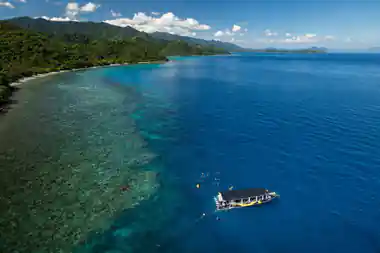
A boat moored over clear reef water, with the crew already preparing for the next snorkellers.
What the Crew Actually Explain
The crew keeps the safety briefing simple. The instructor speaks English, and you will understand the essentials before you leave the terminal.[1] They will cover how the boat works, how to fit the mask, how to clear a snorkel, and what to do if you feel tired in the water. It is delivered clearly, but not rushed, and if you have questions you can put a hand up and ask again.
If you want to try scuba rather than snorkel, introductory diving has a minimum age of 12 years old.[10] You do not need a qualification to ask about it. The crew will tell you what is involved and whether the conditions are right. They will also be honest if the swell or current means a beginner should wait. The decision is never pushed on you.
The useful advice is to ask questions. If you are unsure whether you will manage the swim, tell them. The crew would rather keep you close than lose sight of you, and they are used to every level of confidence. Mention any medical condition, sore ears or recent surgery. It is not a form to be embarrassed about; it is the information they need to look after you properly.
Looking After the Nervous Ones
Nervous swimmers are in good hands. If jellyfish are what you fear, the marine stinger season generally extends from November through May, a time when dangerous jellyfish present a greater risk.[3] In the dry season from May to October, Cairns has sunny skies, low humidity and warm, comfortable days.[2] Those are gentle conditions for a first snorkel, and the crew will point out the sheltered spots where beginners feel most at ease.
In the reef dive areas, the water temperature also helps. From December to February, summer temperatures are 29°C; from June to August, winter temperatures are 24°C.[8] A stinger suit can take the edge off the first minutes in the water. On clear days the surface is calm, the light reaches deep into the coral, and underwater visibility makes the reef easy to enjoy for a hesitant swimmer.
If you have never snorkelled, practise in the shallows first. The crew will stay near you until you find your rhythm. There is no shame in a slow start, and the people who are nervous at the boat often come back grinning. Keep your breathing slow, keep your mask low in the water, and let the buoyancy do the rest. Within a few minutes the idea of floating over a reef stops feeling strange.
from US$125
Book now and settle later for a 4-hour guided snorkeling trip from Cairns, with an English-speaking instructor and no charge for cancellations up to 24 hours ahead.[1]
The Skipper and the Crossing
The crossing is part of the adventure. A stable two-storey pontoon sits offshore on the Outer Reef for a comfortable base.[11] The half-day tour runs for 4 hours, so the skipper keeps the schedule moving.[1] On the way out, the crew sets out the snorkel gear and you start to see the sea change colour as the water deepens.
Should you go to Green Island instead, the island is located 27 kilometres east of Cairns, and the boat ride is about 45 minutes.[12] Reef boats from Cairns leave from the Reef Fleet Terminal at 1 Spence Street.[9] Arrive a little early. You will have time to find the right berth and watch the other boats loading; it is part of the Cairns harbour routine.
If you are prone to seasickness, take precautions the night before and sit low amidships during the crossing. The crew will not make a fuss, but it helps to arrive rested and hydrated. Look at the horizon, keep your face in the breeze, and save the coffee for after you are out of the harbour. A calm stomach makes the first snorkel far easier.
The Humour on a Cairns Snorkel Tour
The humour is part of the experience. A crew that can laugh with you, without ever making you feel silly, makes a reef trip feel more like a day out with friends. They will tease the hesitant snorkeller, cheer the first person to spot a turtle, and keep the energy up on the ride back. You will overhear stories about past trips, local weather, and the fish that got away.
This is what the reviews keep doing: remembering the people. The tour's overall mark is 4.73 from 1,768 reviews.[1] You might forget the exact reef name, but you are unlikely to forget the moment the crew persuaded you to put your face in the water. It is rarely a big speech. It is a quiet word, a nod of encouragement, or someone showing you where the current is gentle.
Humour is not a sales trick; it is how a group relaxes together. By the time the boat heads back to the terminal, strangers are comparing coral sightings and swapping photos. Children are re-enacting their favourite underwater moment, and the nervous swimmer from this morning is already planning the next trip. That shared mood is what turns a boat ride into a memory.
What to Do With This
Book early, but keep your options open. Cancel as late as 24 hours before and still get a full refund.[1] That is useful in the wet season, when a squall can change your plans. You can also reserve now and pay later.[1] Pair the tour with other Cairns activities by booking the reef day first, then filling the rest of your trip around it.
When you come back, the crew can point you to the nearest spot for a rinse and a cold drink near the terminal. If someone in your group would rather stay dry, a semi-submersible seats you one metre underwater in air-conditioned comfort.[13] Book the half-day tour, listen to the crew, and give the reef your full attention. Save the photos for the ride home; while you are in the water, let yourself simply look.
One more thing: leave the reef as you found it. Do not stand on coral, touch turtles, or take anything home. A half-day trip is a privilege, and the crew will show you how to enjoy it without leaving a mark. Sunscreen can also harm coral. Use reef-safe protection and reapply well before entering the water. Small choices like that keep the reef healthy for the next visitor.
Great Barrier Reef by the Numbers
Values from[5].
Compare reef trip prices
Adult from-prices from GetYourGuide listings:[1],[14],[15],[6],[16].
When to book your trip
Get ready for the reef
Book your spot
Reserve now and pay later for US$125, and cancellation is possible up to 24 hours prior.[1]
Find the terminal
Reef boats from Cairns depart from the Reef Fleet Terminal at 1 Spence Street.[9]
Pack for the water
Swimmers, a towel, sun protection and a change of clothes are the essentials.
Listen to the briefing
The English-speaking instructor will go through mask, snorkel and safety.[1]
Take your time
If you try introductory diving, the minimum age is 12 years old.[10]
Cool off after
Rinse off, change and let the sea breeze settle you back into Cairns.
Reserve a half-day reef snorkel with a crew that cares
from US$126Reserve now & pay later