The main points
- You want to remember the reef, but a phone in a waterproof pouch is awkward. A half-day snorkelling tour turns the camera work over to people who know the water.
- On this 4-hour Cairns tour, an English-speaking instructor is there to guide you, and the crew can handle the photography while you swim.[1]
- Expect the classic shots: coral gardens, a green turtle, big fish, and you emerging from the water with salt hair and a grin.
- Bring a small waterproof camera or a floating strap. Ask the crew where the turtles are, and shoot in bursts to keep the good frames.
- On a reef with over 1,600 species of fish and over 600 species of corals, the pictures are the souvenir you can actually share.[2]
- Top choice Half-Day Snorkel from US$125 Duration4 hours[1]Rating4.73[1]SuitsSnorkellers who want to get wet Check availability
- Reef Hopper Flight from US$202 Duration40 minutes[3]Rating4.81[3]SuitsAerial views of reef and rainforest See this tour
- Daintree & Mossman Gorge from US$151 Duration11 hours[4]Rating4.58[4]SuitsRainforest river and gorge scenery See this tour

Every tour departs from the Reef Fleet Terminal, 1 Spence Street, Cairns .
A half-day reef photo plan that works
Before you board
- Meet at the Reef Fleet Terminal in Cairns and leave time to check in
- Pack sunscreen, a hat and sunglasses for the open-water ride
- Ask about protective stinger suits if you are visiting in the warmer months
- Keep your booking confirmation and photo ID handy
On the water
- Clip your camera to a floating wrist strap before you enter
- Ask crew members where turtles and coral gardens are showing up
- Sit outside on the return crossing to let the salt air dry your hair
- Write your name on the SD card before handing it to anyone
The problem this solves
You are in the water, holding a phone in a pouch, trying not to drop it while a sea turtle swims past. Half your attention goes to the camera and half to staying afloat, so the shot usually comes out blurry. The lens fogs, the strap tangles, and the moment drifts away. A reef trip does not have to work like that, and once you let someone else think about the camera, the whole morning changes.
The half-day tour from Cairns keeps the photography simple. This 4-hour experience is led by an English-speaking instructor, and cancellations made at least 24 hours in advance are fully refunded if your plans change.[1] The crew know where the turtles rest and which bommies hold the brightest coral. Your job is to float, breathe and take it in. When you come back to the surface, the pictures are already waiting; you just have to enjoy the ride.
The real problem is distraction. You did not travel all the way to tropical Queensland to watch the reef through a tiny screen. The half-day format keeps the total tour at 4 hours, so you stay in the moment and still go home with something to share.[1]
Great Barrier Reef snorkeling tours Cairns and who holds the camera
Cairns is the natural starting point for a reef day. Boats depart from 1 Spence Street, the Reef Fleet Terminal[5], and Sunlover's Moore Reef pontoon is located 47 km offshore, out on the Outer Reef.[6] That crossing is part of the fun: the coast slides away, the water turns clearer, and the first sand cays appear on the horizon. By the time the engines slow, you have already left the city behind.
This half-day snorkelling tour is a compact version of the classic reef day. It starts with check-in at the terminal, rides out to a stretch of reef, and gets you into the water with an English-speaking instructor.[1] It also leaves your afternoon free, which suits people who would rather spend the evening at the Esplanade Lagoon than another hour on a boat. A shorter cruise means less time bracing against the swell and more time with your face in the water.

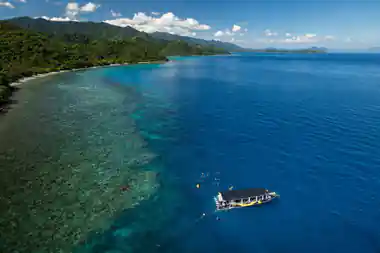
A reef boat moored above a sunlit garden of staghorn coral.
What it frees you from
When a camera is handled for you, your hands are free for your mask, your fins and the first nervous breath of the day. You stop worrying about salt spray, sticky sunscreen and the moment your phone slips out of a pocket. Instead you can concentrate on the rhythm of a reef swim: slow breathing, steady fins and the occasional glance up to see where the boat has drifted. When a turtle appears, you can just watch it.
There is a lot waiting below the surface. The Great Barrier Reef is home to over 1,600 species of fish, over 600 species of corals and six of the world's seven species of marine turtle.[2] Every few minutes the seabed changes, from sandy patches to staghorn gardens to deep-blue drop-offs. Almost every snorkel turns up something new, and almost every photo looks different from the one before it.
If you would rather have your own shots, you can still take them. Many small cameras fit in a buoyancy vest pocket, and the crew can suggest the best time to enter the water. The key is to keep the camera on the surface until you are comfortable, then duck down for one or two focused frames.
What tends to be in them
The best reef photos are the ones you would never dare to take with a phone. A green turtle rising from a coral garden, a school of silver fish turning as one, a starfish wedged in a bommie, and you in a mask peering over the edge. The light changes as clouds pass, so the water shifts from deep navy to pale aqua in a single breath. Good waterproof cameras handle all of it, but they still need someone to hold the shutter steady.
There are also wide shots of the boat moored in turquoise water and close-ups of the reef structures themselves. If you want a view without getting wet, a semi-submersible lets you sit one metre underwater in air-conditioned comfort while the reef glides past.[7] It is a dry, easy way to see what the snorkellers are looking at, and it makes a useful backup when the wind picks up. Crew members usually know where to position the boat so the light falls in the best way.
from US$125
A half-day snorkelling cruise from Cairns with an English-speaking instructor, strong traveller reviews and a booking policy that lets you change plans.
If you want your own pictures too
Some travellers prefer to shoot their own footage, and that is easy too. A small waterproof camera with a floating wrist strap beats a phone in a bag; you can let go at any moment and it will not sink. Shoot in bursts, keep your elbows tucked, and let the fish come to you instead of chasing them. If you are new to the water, practice with the mask on the surface before you dive down.
Before you board, agree with a friend or crew member on who holds the camera in the water. On the half-day tour, the instructor speaks English; questions are easy to ask.[1] If you are weighing up scuba later, the minimum age for introductory diving is 12 years old.[8] For now, keep the day simple: one camera, one buddy, and a clear plan to meet back at the boat when you are ready.
Great Barrier Reef snorkeling and what a photograph is worth
A photo is not the same as being there, but it is a way to prove to your future self that the reef was exactly that blue. It also records a reef that is always changing. The latest AIMS monitoring reports show the northern Great Barrier Reef's hard coral cover rose from 30.0% in 2025 to 35.1% in 2026.[9] Corals grow slowly, fish come and go, and a picture fixes one small moment of that motion for you.
This entire reef network extends more than 2,300 kilometres and contains approximately 3,000 separate coral reefs.[10] Every boat trip finds a slightly different underwater world. A photo from your own mask becomes your small piece of that larger story, and it carries the sound of your own breathing in the memory even if the image itself is silent.
Remember that the reef is a natural place. Turtles move at their own pace and fish do not follow a script. The half-day tour gives you a set window on the water, but the reef decides what appears. The best photographers stay patient and shoot the same coral garden from a few angles until the light cooperates.
How to get the most out of it
Go with the season. In Cairns, dry months are about May to October, and wet months around December to March.[11] The dry half of the year is a sensible time to plan a reef day.
Reef water in winter averages 24°C (June to August), and in summer it averages 29°C (December to February), so a light layer helps during cooler months.[12] Typically, the season for marine stingers runs November through May.[13] Check what the crew offers before you jump in, and keep your camera on a short leash until you find your rhythm. With the right timing and a little patience, the reef does the rest.
Finally, pack for the boat ride as much as the swim. Sunscreen, a hat and a light cover-up protect you on the open water, and a bottle of water helps you stay comfortable. Once you are back at the terminal, the snorkelling is over but the photos still make you grin.
Reef trip ratings compared
Ratings from GetYourGuide listings[1],[14],[15],[16],[17],[18].
Reef day trip budgets from Cairns
US dollar from-prices from GetYourGuide listings[1],[19],[3].
When to plan your reef trip
Making reef photos last
Keep it close
A waterproof camera on a floating hand strap is easier to manage than a phone in a case. Stay steady, breathe out slowly, and let the fish come to you.
Ask before you splash
Crews know where the turtles and coral gardens are. On the half-day tour, the instructor speaks English, so it is easy to ask for tips.[1]
Shoot in bursts
Take a rapid burst of shots of the same turtle or angelfish. Some frames usually keep the tail in view. Burst mode helps when the boat rocks on the swell.
Frame the reef itself
A wall of staghorn coral, a sweep of sand, or a boat from above can tell the reef story better than a selfie. Give your photos a sense of place.
Back up that night
Move your photos from the SD card to a phone or laptop while the day is fresh. Add a note about the reef name so the file still means something later.
Book your Cairns reef snorkeling cruise and keep the photos forever
from US$126Reserve now & pay later