The main points
- Stingers can appear in other months too, and the marine stinger season typically runs November to May.[1]
- A Great Barrier Reef stinger suit is a stretchy, full-length layer that covers arms and legs. It keeps skin protected in the water and is simple to pull on over swimwear.
- The featured half-day snorkelling tour takes 4 hours, costs from US$125, and is led by an English-speaking instructor.[2]
- Reef boats from Cairns depart from the Reef Fleet Terminal at 1 Spence Street, Cairns.[3]
- The dry season, which runs May through October, brings sunny skies, low humidity, and comfortably warm days.[4]
| Stinger season | Dry season | Wet season | |
|---|---|---|---|
| Months | November to May[1] | May to October[4] | December to March[4] |
| Conditions | Higher stinger risk[1] | Sunny skies, low humidity[4] | Warm to hot, humid conditions[4] |
| What to wear | Stinger suit in the water | Sun protection and light layers | Light layers for rain |
| Diving advice | Follow crew guidance | Plan around dry-season days | Watch the daily forecast |
While marine stingers may be present throughout the entire year in tropical Queensland, the risk associated with these two types of potentially dangerous jellyfish are higher during the ‘marine stinger season’ that typically runs from November through to May.
Suit up and get in the water
Ahead of the trip
What the season is
'Stinger season' is the name given to the warmer months when the risk from dangerous jellyfish on the Queensland coast is at its highest. According to Surf Life Saving Queensland, stingers can appear at any time of year, though the danger increases during the marine stinger season, which usually lasts from November to May.[1] The same broad months line up with Cairns' wet season, which is roughly December to March, bringing warm to hot, humid days and the chance of sudden showers.[4] It is a shift you feel as soon as you step outside: the air is heavier, the showers arrive quickly, and the sea feels bath-warm. For visitors used to cooler climates, this is simply tropical Queensland doing what it does.
None of this means the reef shuts down. Tour boats continue to run, and crews watch conditions closely and set the day's plan accordingly. On board, the practical routine is simple: listen to the safety briefing, keep sunscreen on, and follow the crew's advice in the water. If the crew asks everyone to stay in a marked swimming area, that request comes from local knowledge of the day's tides, wind and currents.
Booking a reef trip is still a good idea in stinger season. The featured half-day snorkelling tour from Cairns runs for 4 hours, costs from US$125, is led by an English-speaking instructor, and allows free cancellation up to 24 hours in advance.[2] The shorter timing also leaves room for a slow breakfast, a wander along the Esplanade, or an early dinner after you are back on shore.
Great Barrier Reef stinger suit, and what it does
A Great Barrier Reef stinger suit is a close-fitting, full-length layer, usually lycra or thin neoprene, worn over or under your swimwear. It covers the arms, torso and legs so that skin is not left exposed to anything floating in the water. As a bonus it protects against sunburn and adds a little warmth. It is not a heavy wetsuit; it is light, flexible and quick to pull on. Most people put it on over their swimsuit, check the fit at the shoulders, and forget about it until it is time to jump in.
Reef dive grounds see average water temperatures of 24°C in winter; in summer the average is 29°C.[5] That is warm enough that a stinger suit is often more comfortable than a thick wetsuit. The reef itself gives you plenty of reasons to get in: it is home to over 1,600 species of fish, over 600 species of corals, and six of the world's seven species of marine turtle.[7] Even a short float over a coral bommie can turn into a long one when a turtle drifts into view.

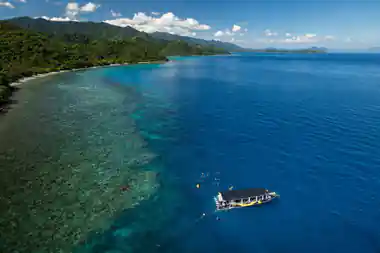
Looking down on turquoise water and a moored reef boat, the classic view from a Cairns reef trip.
The two species that matter
The two types Queensland lifeguards pay closest attention to are the box jellyfish and the Irukandji. The official advice is that the risk from these two potentially dangerous jellyfish is higher during the marine stinger season that typically runs from November through to May.[1] Both can be hard to spot in the water, and neither looks threatening from the surface.
A stinger suit is your barrier if you brush against something you did not see. The water can look perfectly clear right next to a jellyfish, and the suit's job is to cover as much skin as practical. Keep hands and face exposed but avoid touching anything, and stick with the group. Crew decisions about where to stop and how long to pause are made with the day's conditions in mind, and their calls carry the final word.
Why the outer reef is different
Trips that aim for the outer reef spend longer in open water, away from the sheltered coast. Sunlover's Moore Reef pontoon lies 47 km from shore on the Outer Reef.[8] The ride out is part of the experience: the coast thins behind you, the water colour shifts, and the first reef patches appear as pale shapes under the surface.
Though closer choices save time, they remain genuine boat excursions: Green Island sits 27 km east of Cairns, roughly 45 minutes away by boat.[9] Whichever style you choose, the routine is the same: suit up, brief, get in, swim, and warm up on the way back. For a tight schedule, the featured half-day tour keeps the whole outing short enough to leave an afternoon for Cairns. That might mean time for the lagoon, a riverside walk, or simply a long lunch with the boat crowds behind you.
from US$125
The 4-hour featured Cairns half-day snorkelling tour offers an English-speaking instructor and cancellation at no charge up to 24 hours ahead.[2]
Wetsuit or stinger suit
The difference between a stinger suit and a wetsuit comes down to thickness and warmth. A stinger suit is light lycra, designed for protection rather than insulation. A wetsuit's neoprene is thicker, warmer and gives a little buoyancy. Divers often wear full wetsuits; snorkellers are usually fine in a lighter suit. Winter reef water averages 24°C, summer averages 29°C, so either option works well.[5]
Think about what you will actually do. If you plan to lie on the surface and look down, a stinger suit is easy. If you want to try introductory scuba, the minimum age is 12 years old and the crew will fit you with appropriate gear.[10] Book the half-day tour starting at US$125, and you may cancel at no charge up to 24 hours ahead if the forecast seems unsuitable.[2] A little flexibility helps when the weather is deciding what the ocean will do.
Great Barrier Reef jellyfish season and the practical view
For a practical view of jellyfish season, budget a little extra. The Great Barrier Reef's Environmental Management Charge is $8.50 per full-day passenger per day.[6] It is a small line on the total, but knowing it in advance avoids surprises at the till.
Reef boats leave from 1 Spence Street, Cairns, where check-in takes place at the Reef Fleet Terminal.[3] Give yourself time to park, find the terminal and collect any gear before boarding. A small dry bag, a towel and a light layer for the ride home are worth carrying; the sea breeze can feel cool after an hour in the water.
After the trip, rinse your gear with fresh water, change into dry clothes, and take a slow walk along the waterfront. The crew handles the boat, and you get to enjoy that easy, post-swim glow.
The rest of the year
Outside stinger season, the reef calendar turns idyllic. The dry season, which runs May through October, brings sunny skies, low humidity, and comfortably warm days.[4] Water stays gentle too, averaging 24°C in winter.[5] For dive trips, the crew will set the plan from the day's conditions. You mainly need to turn up ready.
The reef's slow recovery is good news too. According to the latest Australian Institute of Marine Science monitoring, hard coral cover across the northern Great Barrier Reef went up from 30.0% in 2025 to 35.1% in 2026.[11] Whether you go in stinger season or the dry months, the Great Barrier Reef is an easy swim away from Cairns, and a little planning is all it takes to enjoy it. Pack the suit, respect the brief, and let the water do the rest.
Life on the reef
Counts from the Great Barrier Reef Foundation: over 1,600 fish species, over 600 coral species, and six of the world's seven marine turtle species.[7]
Compare reef trip from-prices
Amounts are US$ from-prices for each listed GetYourGuide tour. Sources:[2][12][13][14].
When to go
Plan your reef day
Pick your season
Stinger season is November to May[1]; outside those months stingers may still be present, and the crew's advice matters.
Know your suit
A Great Barrier Reef stinger suit is a light, full-length layer worn over swimwear. It keeps skin covered in the water and lets you focus on the coral.
Book the tour
Lasting 4 hours and priced from US$125, this featured half-day tour allows cancellation at no charge up to 24 hours ahead.[2]
Reach the terminal
Reef boats from Cairns depart from the Reef Fleet Terminal at 1 Spence Street.[3]
Board for the outer reef
Sunlover's Moore Reef pontoon lies 47 km from shore on the Outer Reef.[8] Use the crossing for the safety briefing and to get your suit sorted.
Rinse off afterwards
After the trip, rinse your gear, change into dry clothes, and take a slow walk along the waterfront. The crew handles the boat; you enjoy the post-swim glow.
Ready to pull on a stinger suit and see the reef?
from US$126Reserve now & pay later