The main points
- The half-day snorkel tour runs 4 hours and costs from US$125, a gentle introduction rather than a long day at sea.[1]
- You do not need to swim well to enjoy the reef. Flotation devices and a mask let you drift face-down over coral; ask the crew for help once you are on board.
- An English-speaking instructor is on the trip, and the tour rates 4.73 from 1,768 reviews.[1]
- Reserve today and pay later, with free cancellation until 24 hours prior and a full refund.[1]
- Reef boats from Cairns depart from the Reef Fleet Terminal at 1 Spence Street, Cairns.[2]
| Half-day snorkel tour | Full-day reef cruise | Scenic flight | |
|---|---|---|---|
| From | from US$125[1] | from US$196[3] | from US$202[4] |
| Duration | 4 hours[1] | 1 day[3] | 40 minutes[4] |
| Language | Instructor: English[1] | Live tour guide: English[3] | Driver: English[4] |
| Rating | 4.73 from 1,768 reviews[1] | 4.86 from 241 reviews[3] | 4.81 from 545 reviews[4] |
| Cancellation | Free up to 24 hours[1] | Free up to 24 hours[3] | Free up to 24 hours[4] |
| Suits | First guided snorkel | More time on the water | Dry reef views from the air |
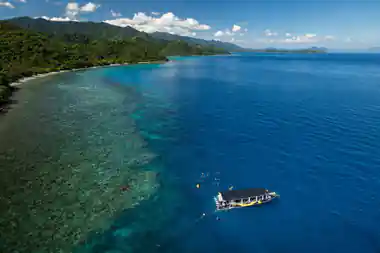
Seated just one metre underwater, experience a diver’s view of the reef as you glide slowly through the reef lagoons and colourful coral gardens in air conditioned comfort.
A gentle, honest first reef snorkel
Know this first
Most people here are beginners
The half-day snorkel tour from Cairns is one of the friendliest introductions to the reef. It lasts 4 hours, is priced from US$125, has an English-speaking instructor aboard, and cancellation is free up to 24 hours before.[1] That short format matters when you are still deciding whether you will like floating in open water. You are back on land before the day turns into a marathon. The reef is vast, stretching over 2,300 kilometres along the Queensland coast and comprising some 3,000 separate coral reefs.[6]
For most first-timers, the question is not whether they can keep up, because there is nothing to keep up with. The trip is rated 4.73 from 1,768 reviews, a sign that other nervous newcomers have enjoyed it too.[1] Reserve immediately and pay at a later time; should your plans alter, cancellation at no charge up to 24 hours before yields a full refund.[1] That combination makes it easy to say yes now and decide later, which is exactly the reassurance a beginner needs.
Beginner-friendly trips are common around Cairns, and the half-day format is about seeing the reef without committing to a full day. You will share the water with other first-timers, and the crew will treat your questions as normal. The point is not to impress anyone, only to float, breathe and look.
What being a non-swimmer means here
On a reef tour, being a non-swimmer simply means you stay near the surface with a flotation aid while a mask and snorkel let you breathe face-down. You do not need strokes, stamina or a swimming certificate. What you need is the willingness to float and look down. Off Cairns, the mean water temperature reaches 24°C during winter and 29°C during summer.[5]
Your energy goes into relaxing, not swimming. The instructor speaks English and is there to help you find your rhythm.[1] If you have never put your face in saltwater, expect a few seconds of surprise; then your breathing settles and the reef appears below you. That is the whole exchange: you trade a little courage for a view of over 1,600 species of fish and over 600 species of corals.[7]

Floating face-down over living coral is the whole point of a first reef snorkel.
Great Barrier Reef snorkeling and the flotation devices
Flotation is your friend. Operators use life jackets, foam noodles and buoyancy vests to keep beginners comfortable, and the crew will fit you before you get in. Let the float do the work and keep your legs relaxed. If you would rather see the reef without getting wet at all, some reef vessels carry semi-submersibles where you stay dry and seated just one metre underwater as the craft glides through coral gardens.[8]
For the half-day snorkel tour, the focus is on being in the water, and you can ask the crew for extra flotation at any point. Reef boats from Cairns leave from the Reef Fleet Terminal at 1 Spence Street, Cairns; check in there and let the crew know that you are a beginner.[2] There is no shame in asking for the longest float on the boat; that is what it is there for.
What the guides actually do
The instructor's main job on a first snorkel is to keep you calm and safe. They explain how to clear a snorkel, fit a mask and use your float, then they enter the water with the group and stay close. On this tour the instructor is English-speaking, and you can ask questions directly.[1] If you tire, you signal and rest; if you are cold, you get back on board. There is no test you have to pass.
Guides also keep an eye on conditions. Tropical Queensland's marine stinger season is usually active from November through to May; during this period dangerous jellyfish present a higher risk.[9] Always follow the crew's directions about where and when to swim. If the idea of going deeper ever tempts you, note that the minimum age for introductory scuba diving is 12 years old, and it is a separate step from snorkelling.[10]
from US$125
Lasting 4 hours, this half-day snorkel trip comes with an English-speaking instructor and free cancellation available up to 24 hours prior to departure.[1]
The first two minutes
The moment of entry is the hardest part, and it passes quickly. Hold the rail or a float, slide in, and keep your breathing slow. Put your face in the water and look down. The first minute is about getting used to the sensation; the second is when the reef appears. Off Cairns, the mean water temperature reaches 24°C during winter and 29°C during summer.[5]
Remember that the boat journey is part of the experience too. On the Outer Reef, the Moore Reef pontoon is located 47 km offshore.[11] You'll find Green Island 27 km east of Cairns if you want a shorter crossing, and the boat ride lasts about 45 minutes.[12] Whichever option you pick, let the crew know it is your first time; they will look after you during those first two minutes.
Snorkeling for non swimmers in Cairns, and honest expectations
Be honest with yourself about what a first reef snorkel is like. You will float over coral gardens, see fish and, if you are lucky, a turtle, but you may also feel awkward in the mask and spend some time just getting your breathing right. That is normal. Across the northern Great Barrier Reef, average hard coral cover in 2026 was 35.1%.[13]
Timing helps. Roughly, Cairns has a wet season from December to March and a dry season from May to October.[14] In tropical Queensland, marine stinger season runs November through to May, when the risk of dangerous jellyfish is higher.[9] A half-day tour from US$125 keeps the commitment small: 4 hours, one short boat ride, and back in Cairns in time to plan something gentle for the afternoon.[1] If you want to see the reef from above instead, a 40-minute scenic flight is another option, from US$202.[4]
A few practical habits help: bring a rash vest, use reef-safe sunscreen, and stay hydrated. Reef trips include the Environmental Management Charge for the Great Barrier Reef; a full-day passenger pays $8.50 per day.[15] Small costs add up, and knowing them in advance keeps the day relaxed.
Bringing a nervous person with you
If you are bringing someone who is anxious, start with the booking terms. Reserve now and pay later, and the decision becomes easier: cancellation is free up to 24 hours in advance and gives a full refund.[1] Tell them they will not be judged, that flotation does the work, and that the instructor is there for exactly this situation.
You can also build confidence the day before if you have access to a calm, shallow swimming spot; practice floating with your face in the water and getting used to the mask. On the morning of the trip, keep things light, arrive early, and let the crew know about the nerves. Most guides have helped hundreds of beginners; for them, a nervous non-swimmer is a normal Tuesday morning.
A first snorkel is not a test of character. If someone only manages a short time in the water, that still counts. The memory that sticks is usually the colour of the coral and the quiet under the surface, not how long you stayed in.
Reef trip from-prices from Cairns
From prices in US$ for Cairns reef experiences: half-day snorkel[1], small-group snorkel[16], full-day cruise[3], outer-reef pontoon[17], scenic flight[4].
Compare reef experiences by price
US$ from-prices from GetYourGuide listings: half-day[1], small group[16], full day[3], pontoon[17], flight[4].
When to think about booking
First-time snorkel plan
Book with room to change
Choose the half-day tour from US$125, reserve now and pay later, and note the free 24-hour cancellation.[1]
Check in at the terminal
For reef trips departing Cairns, make your way to the Reef Fleet Terminal, 1 Spence Street, with your reservation.[2]
Listen to the briefing
The crew shows you how the mask, snorkel and float work together. Ask questions; everyone starts as a beginner.
Get in gently
Hold the rail or a float, put your face down and breathe slowly through the snorkel. In winter the water sits at 24°C, and in summer it reaches 29°C.[5]
Stay with the guide
Keep near the instructor and the group. If you tire, signal and rest on the float; there is no shame in taking it slow.
Celebrate afterwards
Back on board, warm up and enjoy the view. You have snorkelled a reef system spanning more than 2,300 kilometres with some 3,000 individual coral reefs.[6]
Ready to float over the Great Barrier Reef?
from US$126Reserve now & pay later